
Integration of Islamic Education Curriculum Management with Local Content to Strengthen the Moral Character Religio-Cultural Adaptivity of Elementary School Students
DOI:
https://doi.org/10.47453/eduprof.v8i1.462Keywords:
curriculum management, Islamic education, local content, student moralsAbstract
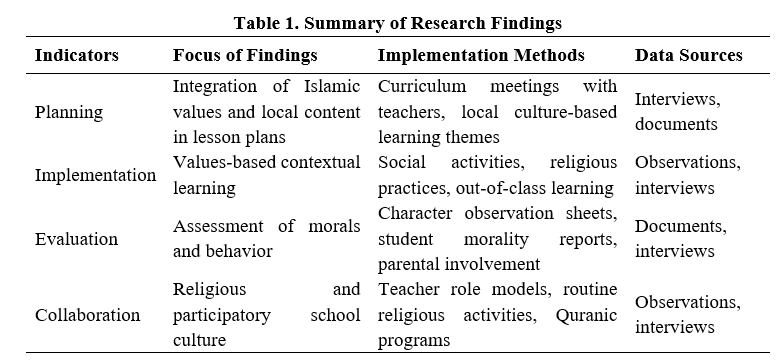
Islamic education in elementary schools plays a vital role not only in building students’ cognitive religious knowledge but also in shaping their moral character deeply rooted in local culture and values. This study explores how the Islamic education curriculum is managed and integrated with local content at SDIT Kasih Ibu, East Karawang District, and examines its effectiveness in strengthening students’ moral development. Employing a qualitative case study approach grounded in curriculum integration theory (Beane, 1997) and local wisdom-based character education (Suyanto, 2018), data were gathered through in-depth interviews with principals, Islamic education teachers, and parents, participant observation of daily learning activities and school routines, and analysis of curriculum documents, lesson plans, and moral development records. Data were analyzed using Miles and Huberman’s interactive model strengthened by the constant comparative technique. The findings reveal three interconnected strategies: curriculum mapping that synergizes Islamic values such as akhlaq karimah and tauhid with local Karawang elements including gotong royong, silih asih, and traditional arts into thematic learning; positioning teachers as moral exemplars through consistent uswah hasanah practices and reflective mentoring; and the development of a habituative school culture via extracurricular activities, daily routines, and hidden curriculum such as subuh pengajian, environmental care, and peer mediation. These holistic and contextual approaches demonstrate that moral strengthening extends far beyond classroom instruction, permeating the entire school environment. Ultimately, this study concludes that integrative curriculum management aligned with local wisdom effectively nurtures students who are religiously grounded, culturally rooted, and socially adaptive, offering valuable insights for sustainable character education in Indonesia.
References
Amin, Husnul, ‘Value-Based Frameworks and Peace Education in Faith-Neutral, Faith-Based and Faith-Inspired Schools in Islamabad: A Comparative Analysis’, Journal of Peace Education, 21.1 (2024), 54–81 <https://doi.org/10.1080/17400201.2023.2289655>
Bailey, Alison L., and Louise C. Wilkinson, ‘Commentary for the Special Issue on Equity and Methodological Advancements to Transform Academic Discourse Teaching and Research. Finding Common Ground: The Path Forward for Building Teacher and Student Capacity for Academic Discourse and Student Success’, Linguistics and Education, 87.April (2025), 101428 <https://doi.org/10.1016/j.linged.2025.101428>
Creswell, Jhon. W., Research Design Pendekatan Metode Kualitatif, Kuantitatif Dan Campuran (Yogyakarta: Pustaka Pelajar, 2019)
Desy, Utari, Miftahul Abidin, Yuniar Yuniar, and Junaidah Junaidah, ‘Integration of General Knowledge and Religion Policy for the Emergence of Integrated Islamic Schools’, International Journal of Education and Literature, 4.1 (2025), 267–78 <https://doi.org/10.55606/ijel.v4i1.217>
Fatimah, Siti, and Siswanto Siswanto, ‘The Role of Moral Education in Children’S Character Development: A Philosophical Perspective in Islamic Elementary Schools’, Journal of Islamic Elementary Education, 2.1 (2024), 52–60 <https://doi.org/10.35896/jiee.v2i1.778>
Firdaus, Salsabila Anita, and Suwendi Suwendi, ‘Fostering Social Harmony: The Impact of Islamic Character Education in Multicultural Societies’, AL-ISHLAH: Jurnal Pendidikan, 17.1 (2025), 942–55 <https://doi.org/10.35445/alishlah.v17i1.6579>
Hendawi, Manal, and Qadhi Saba, ‘Digital Literacy-Based Learning in Islamic Education’, Ar-Fahruddin: Journal of Islamic Education, 1.1 (2024), 45–58 <https://doi.org/10.7401/j19t2q81>
Imroah, Siti, Atik Uminatur Rofi’ah, and Ima Royani, TEORI INOVASI DALAM PENDIDIKAN (PT Arr Rad Pratama, 2025)
Jazuli, and Sukhoiri, ‘Optimalisasi Manajemen Mutu Dalam Meningkatkan Kompetensi Guru Pendidikan Agama Islam’, INNOVATIVE: Journal Of Social Science Research, 5.3 (2024), 69–80 <https://doi.org/10.31004/innovative.v5i3.19735>
Kamal Basir, Mohd Zuhaili, Fariza Md Sham, Nur A.thiroh Masyaa il Tan Abdullah, Muhamad Nasarudin Sulaiman, Fakhira Jafri, Azizu Soteh Ali, and others, ‘Exploring the Role of Digital Da’wah in Promoting Green Initiatives: A Mini Review’, Sustainable Futures, 10.October 2024 (2025), 101099 <https://doi.org/10.1016/j.sftr.2025.101099>
Karim, Abdul, Oman Fathurohman, Sulaiman, Lina Marliani, Fakhri Fajrin Kurniawan, Firman Nugraha, and others, ‘Islamic Spiritual Leadership of Kyai in Fostering Santris’ Entrepreneurial Spirit and Independence in Boarding School’, Social Sciences and Humanities Open, 12.August (2025), 101817 <https://doi.org/10.1016/j.ssaho.2025.101817>
Karim, A., Hamamah, F., Sukardi, D., & Jalaludin. (2024). Kiai Leadership, juvenile delinquency, and pesantren-based rehabilitation: A Henry Minztberg perspective. Asia-Pacific Journal of Educational Management Research, 9(1), 67–74. https://doi.org/10.21742/ajemr.2024.9.1.05
Mansur, and Sholeh Makherus, ‘Journal of Integrated Elementary Education’, Journal of Integrated Elementary Education, 4.1 (2024), 71–82 <https://doi.org/10.21580/jieed.v4i1.20238>
Marnita, Marnita, Diding Nurdin, and Eka Prihatin, ‘The Effectiveness of Elementary Teacher Digital Literacy Competence on Teacher Learning Management’, Journal of Innovation in Educational and Cultural Research, 4.1 (2023), 35–43 <https://doi.org/10.46843/jiecr.v4i1.444>
Masripah, and Mohammad Yufi, ‘The Synergy of Moderate Islam and Curriculum Reform in Character Education’, Sinergi International Journal of Education, 3.2 (2025), 115–23 <https://doi.org/10.61194/education.v3i2.702>
Masturin, Masturin, ‘Development of Islamic Religious Education Materials Based on Religious Moderation in Forming Student Character’, Munaddhomah: Jurnal Manajemen Pendidikan Islam, 3.4 (2023), 246–355 <https://doi.org/10.31538/munaddhomah.v3i4.310>
Miles, M.B, A.M Huberman, and J. Saldana, Qualitative Data Analysis, A Methods Sourcebook, ed. by Tjetjep Rohindi Rohidi, Edition 3. (Depok: UI-Press, 2014)
Moleong, Lexy J, Metodologi Penelitian Kualitatif (Revised Ed.), Bandung: PT. Remaja Rosdakarya (Bandun: Remaja Rosdakarya, 2010)
Moslimany, Raqib, Anzar Otaibi, and Frugo Shaikh, ‘Designing a Holistic Curriculum: Challenges and Opportunities in Islamic Education’, Journal on Islamic Studies, 1.1 (2024), 52–73 <https://doi.org/10.35335/beztg009>
Muslim, Muslim, ‘Internalising Digital Technology in Islamic Education’, Scaffolding: Jurnal Pendidikan Islam Dan Multikulturalisme, 6.3 (2024), 180–97 <https://doi.org/10.37680/scaffolding.v6i3.6309>
Nasrudin, Moh, Pendidikan Sufistik Sebagai Penguatan Moderasi Beragama Di Perguruan Tinggi (Penerbit NEM, 2023)
Nurfaisal, Nurfaisal, Sunengko Sunengko, and M.Fadhly Farhy Abbas, ‘Effective Curriculum Management in Islamic Primary Education: A Case Study of Integrated Islamic Schools’, AL-ISHLAH: Jurnal Pendidikan, 16.4 (2024), 4578–87 <https://doi.org/10.35445/alishlah.v16i4.6211>
Osuji, Gregory Ekene, and A. Oluoch-Suleh Everlyn, ‘CURRICULUM ESSENTIALS A HANDBOOK FOR ASPIRING TEACHERS’ (Franciscan Kolbe Press, PO Box 468, 00217 Limuru (Kenya), 2025)
Pahleviannur, Muhammad Rizal, Anita De Grave, Debby Sinthania, Lis Hafrida, Vidriana Oktaviano Bano, and Dani Nur Saputra, Metodologi Penelitian Kualitatif, Pradina Pustaka, 2022
Peddle, Monica, Rachael Sabrinskas, Thomas Mathew, Caroline Borzdynski, Cindy Hoang, and Hosu Ryu, ‘Registered Nurses’ Perspectives on Co-Designing Undergraduate Nursing Curriculum: A Qualitative Study’, Journal of Professional Nursing, 59.May (2025), 178–88 <https://doi.org/10.1016/j.profnurs.2025.05.001>
Rahman, Najib Aulia, and Azzahra Aisha, ‘The Role of Islamic Education in Preserving Cultural Identity Amidst Global Modernity’, Sinergi International Journal of Islamic Studies, 2.1 (2024), 24–37
Roy, Sudipta, Samia Huq, and Aisha Binte Abdur Rob, ‘Faith and Education in Bangladesh: A Review of the Contemporary Landscape and Challenges’, International Journal of Educational Development, 79 (2020), 102290 <https://doi.org/10.1016/j.ijedudev.2020.102290>
Shahir, Shahira, Xiaoni Ren, and Shaista Noor, ‘Silenced Voices, Enduring Struggles: An Islamic Feminist Analysis of Afghan Female Academics under Taliban Rule’, Women’s Studies International Forum, 113.August (2025) <https://doi.org/10.1016/j.wsif.2025.103193>
Sudirman, Sudirman, Ramadhita Ramadhita, Syabbul Bachri, and Yayuk Whindari, ‘The Transformation of State Islamic Higher Education Institutions into World-Class University: From Globalisation to Institutional Values’, Social Sciences and Humanities Open, 12.June (2025), 101705 <https://doi.org/10.1016/j.ssaho.2025.101705>
Sugiyono, Metode Penelitian Pendidikan (Kuantitatif, Kualitatif, Kombinasi, R & D Dan Penelitian Tindakan) (Bandung: Alfabeta, 2023)
Sumadi, Eko, and Mualimul Huda, ‘Curriculum Management and Implementation of Integrative Learning in Islamic-Based Madrasas in Central Java’, Quality, 13.1 (2025), 75 <https://doi.org/10.21043/quality.v13i1.31380>
Additional Files
Published
How to Cite
Issue
Section
License
Copyright (c) 2026 Authors

This work is licensed under a Creative Commons Attribution-NonCommercial-ShareAlike 4.0 International License.