
Transparency-Based Management and Its Effect on Teacher Performance at Madrasah Tsanawiyah Negeri 9 Indramayu
DOI:
https://doi.org/10.47453/eduprof.v8i1.441Keywords:
management transparency, teacher performance, madrasah management, organizational justice, Islamic educationAbstract
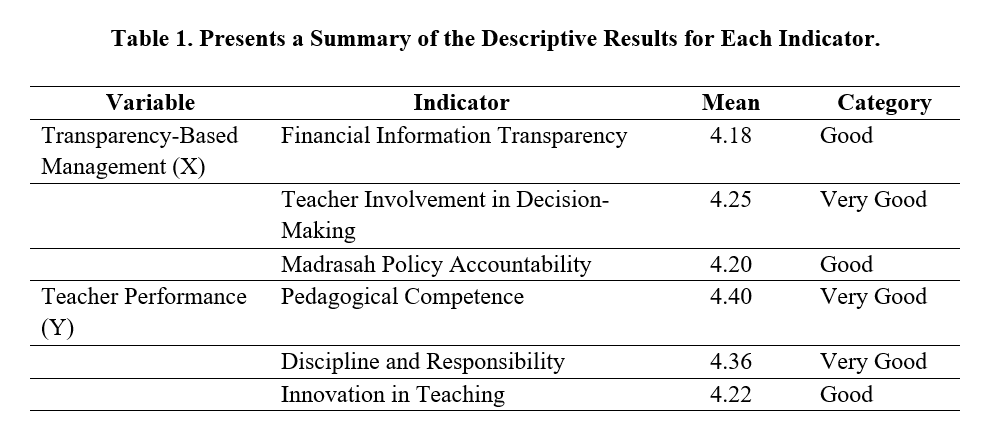
Managerial transparency has become one of the essential principles in the governance of modern educational institutions, including madrasahs. Despite its recognized importance, most existing studies focus on general school settings, leaving the specific dynamics of transparency practices in madrasah contexts underexplored. However, empirical studies examining the influence of management transparency on teacher performance within madrasah environments remain relatively limited. This study addresses this gap by situating transparency within the unique organizational and cultural characteristics of madrasahs. This study aims to analyze the effect of transparency-based management on teacher performance at Madrasah Tsanawiyah Negeri 9 Indramayu. The research employed a quantitative approach using a cross-sectional survey design. Data were collected through a Likert-scale questionnaire involving all permanent teachers as respondents (n = 30) using a total sampling technique. Because the sample consisted of only 30 teachers, the results cannot be widely generalized. Data analysis was conducted using descriptive statistics, validity and reliability tests, and simple linear regression with the assistance of SPSS software. The results indicate that the level of managerial transparency in the madrasah falls within the good category (M = 4.21; SD = 0.42), while teacher performance is categorized as very good (M = 4.33; SD = 0.38). Regression analysis shows that transparency-based management has a positive and significant effect on teacher performance (R = 0.723; R² = 0.523; p < 0.05). This finding indicates that approximately 52.3% of the variation in teacher performance in this study sample can be explained by management transparency practices, while the remaining proportion is influenced by other factors such as intrinsic motivation, the leadership of the madrasah principal, and workload. These results empirically demonstrate that transparency is not merely a procedural aspect of governance but a substantial predictor of teacher performance in faith-based educational institutions. These findings support organizational justice theory, which highlights the role of openness and clarity in building trust and commitment. Furthermore, this study extends the theory by illustrating how transparency operates within a madrasah setting, where formal administrative practices intersect with religious and social values. In madrasahs, managerial transparency functions not only as an administrative mechanism but also as a means to strengthen professional relationships between leaders and teachers. Thus, the study contributes conceptually by contextualizing organizational justice theory in Islamic educational institutions. This study concludes that transparency-based management can improve teacher performance and promote more accountable and participatory governance.
References
AK, M. Fahmi Rofiudlofir., Moch. Varhana Yafrizal, and Irawan. “Metodologi Penelitian Survei Untuk Penelitian Manajemen Pendidikan Islam.” Raudhah Proud To Be Professionals: Jurnal Tarbiyah Islamiyah 7, no. 1 (2022): 268–79. https://doi.org/10.48094/raudhah.v7i1.438.
Al-Ghazali, I. Ihya’Ulumuddin Juz III. Beirut: Dar ihya al-Kutub al-Ilmiyah, 1993.
Asrina. “Implemetasi Manajemen Pendidikan Islam Untuk Mewujudkan Visi Sekolah Bermutu Di MA DDI Lil Banat Parepare.” Jurnal Pendidikan Islam 17, no. 2 (2022): 302.
Brahim, Mehdi Ben, Rym Bougatfa, and Mohamed Amri. “Reliability, Validity and Minimal Detectable Change of a New Multi-Change of Directionagility Test for Soccer Players.” Advances in Physical Education 03, no. 04 (2013): 190–96. https://doi.org/10.4236/ape.2013.34031.
Budiarto, Yoel Agung, Tin Agustina Karnawati, and Dany M. Handarini. “The Impact of School Culture on Teacher Efficacy through Teacher Leadership as an Intervening Variable in Regents Secondary School Bali.” Kelola: Jurnal Manajemen Pendidikan 11, no. 2 (2024): 129–45. https://doi.org/10.24246/j.jk.2024.v11.i2.p129-145.
Fuad, Nurhattati, Fadhillah, and Ahmad Jauhari HR. “Model Transparansi Tatakelola Sekolah Dasar Negeri (SDN) Di Wilayah Jakarta Timur.” Improvement: Jurnal Ilmiah Untuk Peningkatan Mutu Manajemen Pendidikan 9, no. 1 (2022): 82–104. https://doi.org/10.21009/improvement.v9i1.27592.
Gao, Zhengliang, Guangjiao Hu, Shahla Akram, Mehboob Ul Hassan, Muhammad Farrukh Shahzad, and Sajjad Ahmad Jan. “Comparative Analysis of Managerial Strategies for Enhancing Teacher Motivation in Public and Private Schools.” Scientific Reports 15, no. 1 (2025): 1–11. https://doi.org/10.1038/s41598-025-90900-9.
Greenberg, Jerald. “A Taxonomy of Organizational Justice Theories.” Academy of Management Review 12, no. 1 (1987): 9–22. https://doi.org/10.5465/amr.1987.4306437.
Harahap, V A N, N Nurwani, and J Nasution. “Analysis of Accountability and Transparency in Management of School Operational Assistance (BOS) on School Progress at SMP Muhammadiyah 16 Lubuk Pakam.” Indonesian Interdisciplinary Journal Of Sharia Economis (IIJSE) 6, no. 3 (2023): 1863–77.
Hasanah, R. “Financial Accountability and Transparency in Madrasah Management: Implications for Educational Quality.” Journal of Education Management and Policy 1, no. 1 (2025). https://ejournal.unuja.ac.id/index.php/jemp/article/view/10969%0Ahttps://ejournal.unuja.ac.id/index.php/jemp/article/viewFile/10969/4253.
Jansen, Marijn, and Haiko Van Der Voort. “Adaptive Governance: Towards a Stable, Accountable and Responsive Government.” Government Information Quarterly 33, no. 1 (2016): 1–5. https://doi.org/10.1016/j.giq.2016.02.003.
Karim, Abdul, Oman Fathurohman, Sulaiman Sulaiman, Lina Marliani, Muhammadun Muhammadun, and Bambang Firmansyah. “How Do Principals Act as Leaders and Managers in Boarding and Public Schools in Indonesia?” Cogent Education 12, no. 1 (2025). https://doi.org/10.1080/2331186X.2024.2445354.
Khoirul Anwar, M. Darul Fathoni, and Hufron. “Penerapan Prinsip Efisiensi Dan Transparansi Dalam Pengelolaan Dana BOS: Implikasinya Pada Mutu Pendidikan.” Akademika: Jurnal Manajemen Pendidikan Islam 6, no. 2 (2025): 319–29. https://doi.org/10.51339/akademika.v6i2.3568.
Lane, Jan-Erik. New Public Management. London: Routledge, 2000.
Maslufi, Lulu Zusratul, Andriani Maryam, and Maria Florentina Seno. “Pengaruh Transparansi Dan Tanggung Jawab Pengelolaan Keuangan Sekolah Terhadap Efektivitas Pemanfaatan Anggaran Sekolah.” Jurnal Bisnis Dan Akuntansi Unsurya 10, no. 2 (2025). https://doi.org/10.35968/jbau.
Mukarom, Zaenal, Deni Darmawan, Mubiar Agustin, Jeane Siti Dwijantie, and Mochamad Ramdan Samadi. “The Transparency of The Management of School Operational Assistance (BOS) Funds at SMP Negeri 230 Jakarta.” International Education Trend Issues 2, no. 2 (2024): 317–28. https://ijble.com/index.php/iet.
Nuriyawati, Nuriyawati, Maryanto Maryanto, and Ghufron Abdullah. “Pengaruh Transparansi, Akuntabilitas, Dan Partisipasi Masyarakat Dalam Pengelolaan Dana Bos Terhadap Mutu Pendidikan.” SOCIAL : Jurnal Inovasi Pendidikan IPS 5, no. 1 (2025): 143–51. https://doi.org/10.51878/social.v5i1.4689.
Nurjaman, Irman, Muflihun, Rijal Muhamad Kosim, Badrudin, and Qiqi Yuliati Zaqiah. “Implementasi Prinsip Efisiensi Dan Transparansi Manajemen Pembiayaan Di Tengah Penurunan Pendaftar Di MTs Al Amin Sindangkasih.” Islamic Management: Jurnal Manajemen Pendidikan Islam 8, no. 2 (2025): 785–98. https://doi.org/10.30868/im.v8i02.8621.
Obeng, Anthony Frank, Yongyue Zhu, Samuel Awuni Azinga, and Prince Ewudzie Quansah. “Organizational Climate and Job Performance : Investigating the Mediating Role of Harmonious Work Passion and the Moderating Role of Leader – Member Exchange and Coaching.” SAGE Open Journal, 2021, 1–14. https://doi.org/10.1177/21582440211008456.
Putri, Dela Septiani, Yulia Saftiana, Saadah Siddik, and Kushendar Kushendar. “The Influence of Accountability, Participation, and Transparency of Boss Funds on the Financial Performance of Public Elementary Schools in Palembang City.” JMKSP (Jurnal Manajemen, Kepemimpinan, Dan Supervisi Pendidikan) 8, no. 1 (2023): 329–43. https://doi.org/10.31851/jmksp.v8i1.11810.
Rahyu, Putri, Rafiuddin Rafiuddin, and Muhammad Zia Ulhaq. “Etos Kerja Dalam Pandangan Agama Dan Pengaruhnya Terhadap Pembangunan Ekonomi Islam.” J-ESA (Jurnal Ekonomi Syariah) 6, no. 2 (2023): 79–88. https://doi.org/10.52266/jesa.v6i2.2317.
Rodliyah, Siti. “Leadership Pesantren: Urgensi Pendidikan Dalam Menyiapkan Pemimpin Bangsa Berkualitas Dan Bermoral.” MANAGERIA: Jurnal Manajemen Pendidikan Islam 4, no. 1 (2019): 169–82. https://doi.org/10.14421/manageria.2019.41-10.
Roselidyawaty, Nor, and Mohd Rokeman. “Likert Measurement Scale in Education and Social Sciences: Explored and Explained.” EDUCATUM Journal of Social Sciences 10, no. 10 (2024): 77–88. https://doi.org/10.37134/ejoss.vol10.1.7.2024.
Sugiyono. Metode Penelitian Kuantitatif, Kualitatif Dan R & D. Bandung: Alfabeta, 2024.
Additional Files
Published
How to Cite
Issue
Section
License
Copyright (c) 2026 Authors

This work is licensed under a Creative Commons Attribution-NonCommercial-ShareAlike 4.0 International License.