
Development of Islamic Education Teaching Materials Based on Applied Behavior Analysis (ABA) and Positive Behavior of Disabled Students
DOI:
https://doi.org/10.47453/eduprof.v8i1.446Keywords:
Teaching Materials, ABA, Mentally Retarded ChildrenAbstract
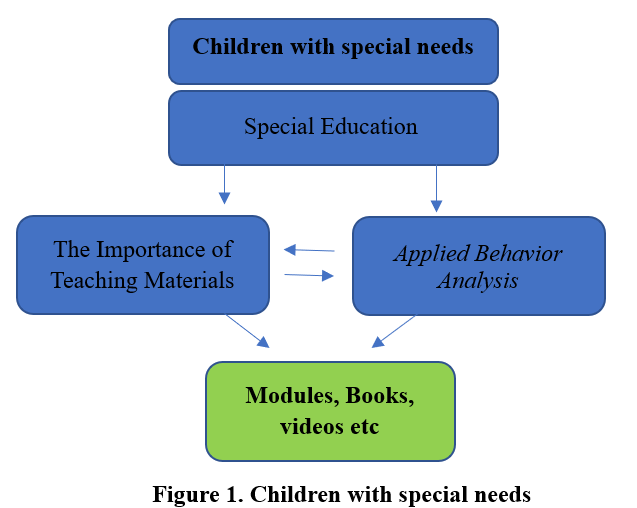
Islamic Religious Education (PAI) is intended to reach every student, including children with intellectual disabilities (tunagrahita). In practice, however, specialized PAI teaching materials for these children are virtually nonexistent. Teachers still rely on textbooks designed for typically developing students or create their own modules without using appropriate methods, directly contradicting National Education Law No. 20 of 2003, Article 5 Paragraph 2, which mandates special education for citizens with physical, emotional, mental, intellectual, or social disabilities. Previous studies on PAI for children with special needs have only described conventional planning and evaluation without developing tailored approaches. This study aims to develop ABA-based PAI teaching materials for children with intellectual disabilities. It employs a literature review method by systematically collecting, reading, recording, and analyzing journals, books, and documents on teaching materials and Applied Behavior Analysis (ABA).The findings demonstrate that ABA-based PAI materials are critically needed. ABA, originally developed for autism, has proven highly effective for other disorders such as ADHD and Asperger’s syndrome, as well as for typically developing children. For tunagrahita students facing significant intellectual and adaptive limitations, this approach systematically shapes specific behaviors into socially acceptable ones and optimally supports PAI competency mastery. In conclusion, ABA-based PAI teaching materials represent a vital innovation that fulfills the national legal mandate for meaningful and inclusive Islamic Religious Education
References
Adjeng, RAden Roro Jane, and M Ilmi Hatta. "The Effect of ABA Therapy on Social Interaction of Autistic Children at SLB Autis Prananda Bandung." Research Proceedings of Unisba Academic Community (Social and Humanities) 2 (2014): 430–36.
Agustin, Liliza, Sutardjo A.W, and Makmuroh Sri Rahayu. "Group Counseling Based on Tazkiyatun Nafsi Self-Management Technique: A Psychological Intervention in Improving Self-Direction in Student Learning." Journal of Psychology 13, no. 1 (2018): 1. https://doi.org/10.24014/jp.v13i1.2399.
Cahyadi, Rahmat Arofah Hari. "Development of Teaching Materials Based on Addie Model." Halaqa: Islamic Education Journal 3, no. 1 (2019): 35–42. https://doi.org/10.21070/halaqa.v3i1.2124.
Duckworth, Angela L., Tamar Szabó Gendler, and James J. Gross. “Situational Strategies for Self-Control.” Perspectives on Psychological Science 11, no. 1 (2016): 35–55. https://doi.org/10.1177/1745691615623247.
Dwi Marsela, Ramadona, and Mamat Supriatna. "Self-Control: Definitions and Factors." Journal of Innovative Counseling: Theory, Practice & Research 3, no. 2 (2019): 65–69. http://journal.umtas.ac.id/index.php/innovative_counseling.
Grey, Ian M. “EEvaluating the Effectiveness of Teacher Training in Applied Behaviour Analysis Ian Grey, Rita Honan, Brian McClean, Michael Daly.” Journal of Intellectual Disabilities 9, no. 3 (2005): 209–27. http://www.ncbi.nlm.nih.gov/pubmed/16144826%5Cnhttp://jld.sagepub.com/cgi/doi/10.1177/1744629505056695%5Cnhttps://www.researchgate.net/publication/7616267_Evaluating_the_effectiveness_of_teacher_training_in_Applied_Behaviour_Analysis.
Handojo. Autism. Jakarta, 2006.
Hernawan, Asep Herry, Hj Permasih, and Laksmi Dewi. "Teaching Material Development." Directorate of UPI, Bandung 4, no. 11 (2012): 1–13.
Khasanah, Siti Badrotil. "Development of Learning Methods in Islamic Religious Education (Cooperative Learning)." Treatise, Journal of Islamic Education and Studies 9, no. 1 (2023): 422–30.
Kirkham, Patrick. “‘The Line between Intervention and Abuse’ – Autism and Applied Behaviour Analysis.” History of the Human Sciences 30, no. 2 (2017): 107–26. https://doi.org/10.1177/0952695117702571.
Larasati, Manggi Asih, and Meita Santi Budiani. "The Relationship Between Self-Control and Impulse Purchase of Clothes in Psychology Students of the State University of Surabaya who made online purchases." Character : Journal of Psychological Research 02, no. 1 (2014): 1–8. https://ejournal.unesa.ac.id/index.php/character/article/view/11000.
Lass, Scott. "The contribution of comprehensive professional counseling services to BMB3 strategy and the formation of structured positive behaviors towards problem alleviation and prevention of early marriage." Educatum: Journal of Educational Sciences 1, no. 1 (2022): 181–93. https://educatum.marospub.com/index.php/journal/article/view/50.
Latifah, Sri, and Ardini Utami. "Development of Interactive Teaching Materials Based on Social Media of Schoology." Indonesian Journal of Science and Mathematics Education 2, no. 1 (2019): 36–45. https://doi.org/10.24042/ijsme.v2i1.3924.
Magdalena, Ina, Fitri Ramadanti, Rideva Az-Zahra, Keywords, : Learning, and Teaching Materials. "Analysis of Teaching Materials in Learning and Teaching Activities at Sdn Karawaci 20." EDITION: Journal of Education and Science 3, no. 3 (2021): 434–59. https://ejournal.stitpn.ac.id/index.php/edisi.
Magdalena, Ina, Tini Sundari, Silvi Nurkamilah, Dinda Ayu Amalia, and University of Muhammadiyah Tangerang. "Analysis of Teaching Materials." Journal of Education and Social Sciences 2, no. 2 (2020): 311–26. https://ejournal.stitpn.ac.id/index.php/nusantara.
Maulana, Mirza. Autistic children. Yogyakarta, 2008.
MN, Ghufron and Risnawati. Psychological Theories. Yogyakarta, 2012.
Mufida, Elly, Martini Martini, and Ady Hermawan. "Designing Parenting Applatization to Strengthen Children's Positive Behavior by Android-Based Parents." Journal of MATRIC 17, no. 2 (2018): 1–12. https://doi.org/10.30812/matrik.v17i2.78.
Prastowo, Andi. "Creative Guides Make Innovative Teaching Materials Create Interesting and Fun Learning Methods," 2019.
Prihantana, M. A. S., I. W. Santyasa, and I W. S. Warpala. "E-Journal Postgraduate Program of Ganesha University of Education DEVELOPMENT OF INTERACTIVE TEACHING MATERIALS BASED ON CHARACTER EDUCATION IN THE SUBJECT OF ANIMATION STOP Learning Technology Study Program, e-Journal Postgraduate Program of Unive Postgraduate Program." E-Journal of Graduate Program of Ganesha University of Education 4, no. 1 (2014): 1–12.
Pulsation, Hydraulic, and Filtering Technology. “液压脉动滤波技术研究陈耿彪 1 , 贺尚红 2 2.” 4, no. 12We study a family of 'classical' orthogonal polynomials which satisfy (apart from a three-term recurrence relation) an eigenvalue problem with a differential operator of Dunkl type. These polynomials can be obtained from the little q-Jacobi polynomials (2015): 10–14. https://doi.org/10.3969/j.issn.1008-0813.2015.03.002.
Puteri, Adhita Paramitha, and Damajanti Kusuma Dewi. "The Relationship Between Self-Control and Social Support and Learning Motivation in Psychology Students of State University of Surabaya." Journal of Psychological Research 8, no. 6 (2020): 1–13. https://ejournal.unesa.ac.id/index.php/character/article/view/41517.
Ramadhani, Rio. "Interpersonal Communication of Parents and Children in Shaping Children's Positive Behavior in Students of SDIT Cordova Samarinda." E-Journal of Communication Science 1, no. 3 (2013): 112–21. https://ejournal.ilkom.fisip-unmul.ac.id/site/?p=865.
Ritonga, Adelia Priscila, Nabila Putri Andini, and Layla Iklmah. "The Development of Media Teaching Materials." Dehasen Multidisciplinary Journal (MUDE) 1, no. 3 (2022): 343–48. https://doi.org/10.37676/mude.v1i3.2612.
Riza, Ade, and Rahma Rambe. "Correlation between Parental Social Support and Self‐Directed Learning in High School Students" 37, no. 2 (2010): 216–23.
In fact, Sigit. "Theory and Application of Behavioristic Approaches in Abstract Counseling Preliminary Theories and Behavioristic Approaches." Paradigm, no. 14 (2012): 1–11.
Setia Lestari. "The Influence of Management Commitment, Positive Behavior of Health Workers and Health Office Support on the Quality of Service at Uptd Puskesmas in South Barito Regency, Central Kalimantan Province." Kindai 17, no. 2 (2021): 227–41. https://doi.org/10.35972/kindai.v17i2.651.
Soeriawinata, Rury. Verbal Behavior and Applied Behavior Analysis (ABA) help children with autism and ABK find language functions. Jakarta, 2016.
Suciati, et al. "Guidelines for the Development of Interactive Teaching Materials." Open University, 2018, 79. http://repository.ut.ac.id/id/eprint/9408.
Syaifullah, Muhammad, and Nailul Izzah. "A Theoretical Study of the Development of Arabic Language Teaching Materials." Arabic : Arabic Journal 3, no. 1 (2019): 127. https://doi.org/10.29240/jba.v3i1.764.
Ulfiah, U. "Adjustment of Self Direction Skills of Students of the Cipadung Cibiru Universal Islamic Boarding School, Bandung City." Islamic Education: Journal of Islamic Education 10, no. 01 (2021): 507–26. http://jurnal.staialhidayahbogor.ac.id/index.php/ei/article/view/1377.
Zain, Muhammad. "Development of Learning Strategies and Selection of Teaching Materials." Inspirative Education 6, no. 1 (2017): 172. https://doi.org/10.24252/ip.v6i1.4925.
Additional Files
Published
How to Cite
Issue
Section
License
Copyright (c) 2026 Authors

This work is licensed under a Creative Commons Attribution-NonCommercial-ShareAlike 4.0 International License.