
The Integration of Digital Technology in Islamic Education: Enhancing Learning Outcomes and Preserving Religious Values
DOI:
https://doi.org/10.47453/eduprof.v8i1.431Keywords:
Digital Technology, Islamic Education, Learning Outcomes, Religious Values, Digital EraAbstract
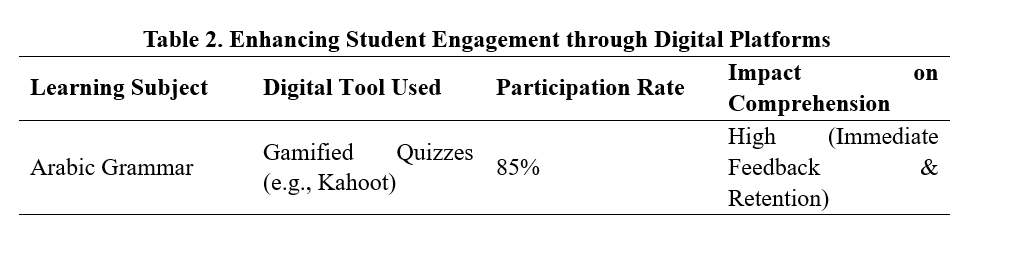
The rapid advancement of digital technology has reshaped the global educational landscape, yet its adoption within Islamic education remains complex due to the unique emphasis on character cultivation and spiritual values. This study analyzes the integration of digital technology in Islamic education with a focus on how it enhances learning outcomes while preserving religious values. As education increasingly shifts towards digital platforms, Islamic education faces both opportunities and challenges in adopting modern tools without compromising its spiritual essence. This study employed a qualitative research design, utilizing semi-structured interviews with teachers, administrators, and students, alongside classroom observations and document analysis at madrasahs, pesantren, and Islamic universities. Participants were selected through purposive sampling to provide information-rich insights into technological implementation. The findings show that digital technology can facilitate interactive learning, expand access to educational resources, and improve students’ engagement. At the same time, it is crucial to safeguard Islamic values by carefully selecting and designing digital content that aligns with ethical and religious principles. Specific findings indicate that while gamification and multimedia tools improve comprehension in challenging subjects like Arabic grammar and fiqh, students face challenges such as digital distractions and exposure to unverified religious claims. The study highlights that when appropriately implemented, digital technology strengthens academic achievement and supports students’ holistic development in accordance with Islamic teachings. To ensure success, institutions must implement "Islamic digital citizenship" modules and curate online systems to maintain moral integrity. This integration serves as a strategic step in ensuring that Islamic education remains relevant, effective, and value-driven in the digital era.
References
Abdul Mujib, “Implementation of the Concept of Ta’dib in Islamic Religious Education,” Riayah: Jurnal Sosial dan Keagamaan 7, no. 1 (2022): 15–17; serta “Basic Concepts of Tarbiyah Ta’lim and Ta’dib Education,” BIR: Journal of Islamic Education 3, no. 1 (2025): 5–7.
Abu Hamid al-Ghazali, “The Concept of Moral Education in Imam Al-Ghazali’s Thought as Presented in Ihya’ ‘Ulum al-Din,” dalam Proceeding of International Conference on Islamic Education (ICIE), 2025, 120–122.
Ahmad Fauzi, “Interactive Media in Islamic Education: Enhancing Engagement amid Infrastructure Challenges at Muhammadiyah 12 Senior High School Jakarta,” A satiza: Journal of Islamic Education 7, no. 1 (2025): 45–48.
Ahmad Mudiono, “Digitalizing Islamic Education Management in the Industry 5.0 Era,” Jurnal Manajemen Pendidikan Agama Islam 4, no. 1 (2025): 10–12.
Ahmad Zaki, “The Digital Ummah: Islamic Religious Education as Pathway to Moral Integrity in a Connected World,” Al-Muallim: Journal of Islamic Education 6, no. 2 (2024): 210–212.
Amananti, W. (2024). Dampak teknologi dan komunikasi terhadap pelestarian dan budaya lokal. Jurnal Ilmiah Pendidikan, 4(02), 7823–7830.
Arif Muadzin, & Mustofa, A. (2021). Konsepsi peran guru sebagai fasilitator dan motivator dalam proses pembelajaran Pendidikan Agama Islam. Jurnal Pendidikan Islam, 7(2), 171–186. https://doi.org/10.37286/ojs.v7i2.102
Busro, Mailana, A., & Sarifudin, A. (2021). Pendidikan Islam dalam publikasi internasional: Analisis bibliometrik pada database Scopus. Edukasi Islami: Jurnal Pendidikan Islam, 10(01), 413–426. http://jurnal.staialhidayahbogor.ac.id/index.php/ei/article/view/1591/800
Fadli Hasan, “Digital Citizenship in Islamic Education: Between Innovation and Moral Responsibility,” Journal of Muslim Youth and Media 3, no. 1 (2024): 55–59.
Fathullah, A., & Caroline, C. (2025). Menavigasi tantangan dan peluang pendidikan multisektoral di era digital: Kajian literatur terkini. Jurnal Ilmiah Edukatif, 11(01), 122–132.
George Siemens, “Connectivism: A Learning Theory for the Digital Age,” International Journal of Instructional Technology and Distance Learning 2, no. 1 (Januari 2005)
Hidayat, T., & Syafe’i, M. (2018). Peran guru dalam mewujudkan tujuan pembelajaran Pendidikan Agama Islam di sekolah. Rayah Al-Islam, 2(01), 101–111. https://doi.org/10.37274/rais.v2i01.67
Hidayati, Farida. “Shaping Future Leaders: How Technology Is Transforming Islamic Education in the Digital Age.” At-Turats 17, no. 2 (2023): 40–60.
Huda, M. (2020). Perkembangan pendidikan Islam di Indonesia dan upaya penguatannya dalam sistem pendidikan nasional. Journal of Islamic Education Research, 1(02), 39–53. https://doi.org/10.35719/jier.v1i02.24
Isti’ana, A. (2024). Integrasi teknologi dalam pembelajaran pendidikan Islam. Indonesian Research Journal on Education, 4(1). https://doi.org/10.31004/irje.v4i1.493
John W. Creswell, Qualitative Inquiry and Research Design: Choosing Among Five Approaches, 3rd ed. (Thousand Oaks, CA: SAGE Publications, 2013), 47–48.
Lev Vygotsky, Mind in Society: The Development of Higher Psychological Processes (Cambridge, MA: Harvard University Press, 1978)
Lihat misalnya Ahmad Rahman, “Evaluating the Technical Efficiency of Islamic E-Learning Platforms,” Journal of Islamic Educational Technology 5, no. 2 (2023): 101–104;
Mar, Ahmad Nur. “Integration of Technology and Islamic Education in the Digital Era: Challenges, Opportunities and Strategies.” Journal of Science and Islamic Studies 1, no. 1 (2024): 1–20.
Matthew B. Miles, A. Michael Huberman, and Johnny Saldaña, Qualitative Data Analysis: A Methods Sourcebook, 3rd ed. (Thousand Oaks, CA: SAGE Publications, 2014), 31–33.
Michael Quinn Patton, Qualitative Research & Evaluation Methods: Integrating Theory and Practice, 4th ed. (Thousand Oaks, CA: SAGE Publications, 2015), 264–265.
Mudiono, M. (2025). Transformation of Islamic educational management in the digital era. At Tandhim | Journal of Islamic Education Management, 1(1), 47–57. https://doi.org/10.53038/tndm.v1i1.287
Nur Shalehah, “Transformasi Pendidikan Islam di Era Digital: Rekonstruksi Nilai-Nilai Historis dalam Masyarakat Virtual,” Ihsan: Jurnal Pendidikan Islam 6, no. 2 (2025): 145–148.
Nurul Hidayah, “Modernization and the Erosion of Religious Values in Muslim Education,” Islamic Education Review 12, no. 1 (2022): 33–36.
Rahma, P. A. A., & Mufidah, V. N. (2025). Implementasi teknologi digital dalam pengelolaan kelas pada pembelajaran Pendidikan Agama Islam. Jurnal IHSAN: Jurnal Pendidikan Islam, 3(1), 110–120. https://doi.org/10.61104/ihsan.v3i1.488
Rina Sari, “The Use of Digital Learning Platform as Communication Media for Islamic Education,” Didaktika Religia 12, no. 1 (2024): 60–62.
Saiful Anwar, “Repositioning the Teacher as Murabbi in the Age of Online Learning,” Tarbiyah: Journal of Islamic Pedagogy 10, no. 2 (2022): 77–81.
Shalehah, K. R., Ihsan, F. F., Hibrizi, M. A., Ramadhan, M. N., & Fadhil, A. (2025). Transformasi pendidikan Islam di era digital: Rekonstruksi nilai-nilai historis dalam menyongsong masyarakat virtual. Jurnal IHSAN: Jurnal Pendidikan Islam, 3(3), 551–566. https://doi.org/10.61104/ihsan.v3i3.1529
Sinaga, W. M. B. B., & Firmansyah, A. (2024). Perubahan paradigma pendidikan di era digital. Jurnal Teknologi Pendidikan, 1(4), 10. https://doi.org/10.47134/jtp.v1i4.492
Siti Isti’ana, “Islamic Religious Education Learning Strategies in the Digital Era: Utilization of Social Media and E-Learning,” Educationist: Jurnal Pendidikan Islam 5, no. 1 (2024): 55–58.
Wesnedi, C., Hasibuan, L., & Anwar, K. (2021). Supervisi pendidikan dalam lingkup pendidikan Islam era kontemporer. Al-Riwayah: Jurnal Kependidikan, 13(2), 243–262. https://doi.org/10.47945/al-riwayah.v13i2.407
Additional Files
Published
How to Cite
Issue
Section
License
Copyright (c) 2026 Authors

This work is licensed under a Creative Commons Attribution-NonCommercial-ShareAlike 4.0 International License.